

“Get busy living…or get busy dying.”
This is a line from one of my favorite films, The Shawshank Redemption.
And it was something I had to face in the summer of 2024.
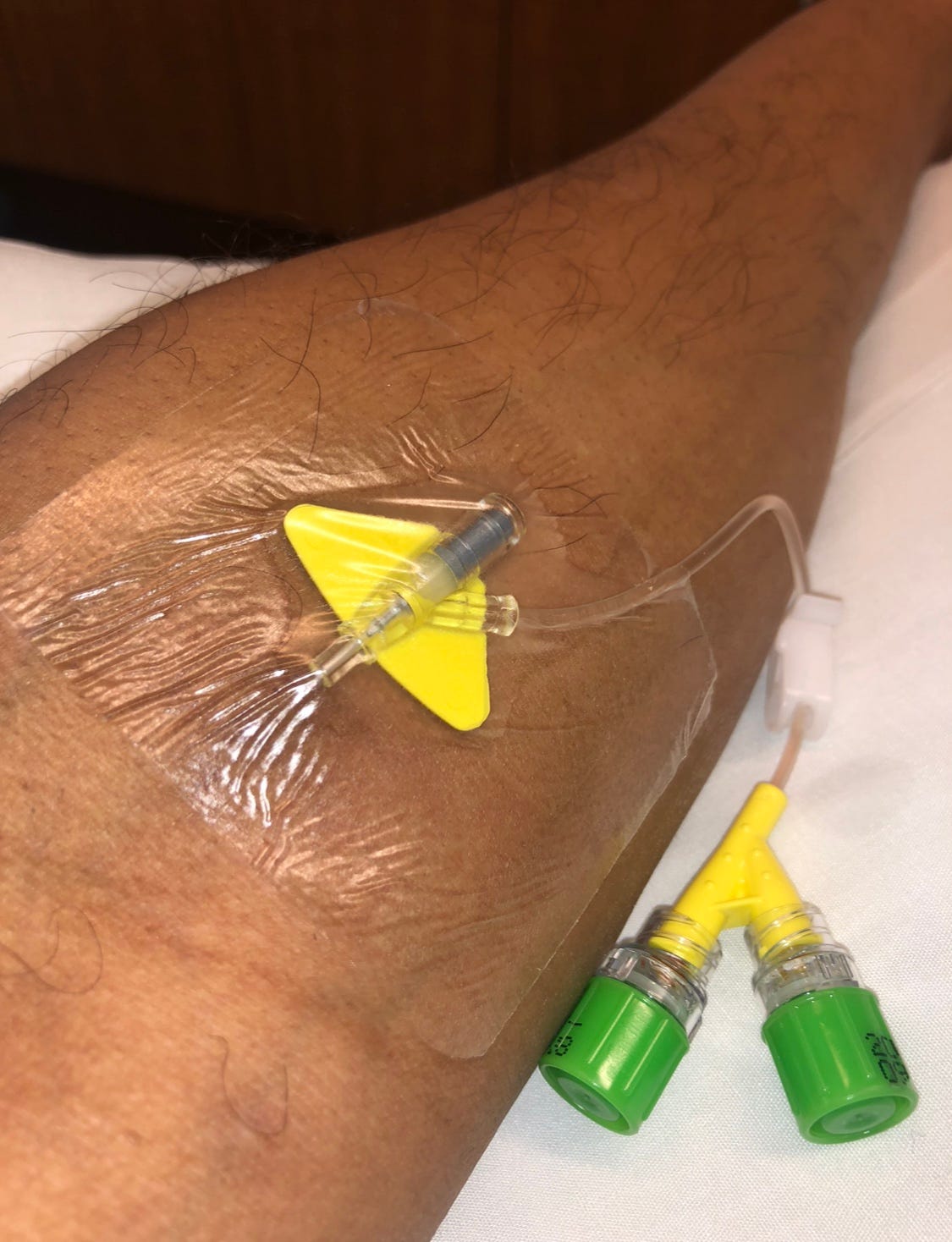
I was lying in a hospital bed, tied to machines that beeped incessantly. Nurses came in every four hours to check my vitals. About a dozen doctors and nurses would arrive each morning to do their rounds. They were treating a critically ill man. A cancer patient. I was right back there again, now a decade later. This time with a more aggressive variant of lymphoma. They were preparing my body to receive my own harvested stem cells. I was in an incubation period lasting four weeks.
Typically, it is three weeks, but I was experiencing tachycardia; every time I would stand up my pulse would rise to 160 or 170. It was so high one night I was rushed to the ICU and given norepinephrine. Sleepless nights. Finding the strength to get out of bed to relieve myself. Every couple of hours, a trip to the toilet. Another mess to deal with. Peeling skin off my fingers. My body was now four shades darker than when I first arrived. Dental implant loosening. Scraggly facial and head hair. Lips rough and dry. Breathing issues. Moments where my energy just lay there flat. No appetite for over a week. In the 29 days I was there, I ended up losing 26 pounds. My face was gaunt. One night, my iPhone’s facial recognition no longer recognized me. It was frustrating.
Not because I needed my iPhone to entertain me, but because it felt like the last piece of my identity had been lost.
Even my passcode didn’t work. There was no one I could call. I felt defeated.
Can you imagine? A small device held that much power in my life? But it wasn’t really about accessing my iPhone. It felt like the last remnant of my life was unavailable to me in that moment. It wasn’t there to distract me. It wasn’t there to soothe me. It wasn’t there to connect me with others. It was a reminder that nothing in this life is truly ours, even though we like to believe it is. So I waited. And waited. A day later, like magic, my iPhone picked up my facial features even though nothing had changed.
The month spent in a quarantine room in the hospital felt like a spiritual exile. It was a place where I could no longer look away from what my body was undergoing. But I learned a few things from my first battle that I kept close to my heart and mind. I didn’t allow circumstances to dictate what I should do next. I mustered the energy every day to greet the nurses and learn from their experiences with previous patients. I looked at the doctors who came to do their rounds and one day exclaimed, “I have asked many nurses who told me everyone was begging to go home. And then as soon as they did, invariably they would have to come back due to a complication or infection. I don’t want to come back here. As much as I would love to go home, I want you to discharge me only when you feel confident I should be released.” They were stunned.
But I knew that I needed to submit and surrender not to the worst possible situation, but to what this moment was trying to get me to see. What is the mystery? What is this pain trying to show me? What am I called here to experience? I sank deeply into those lonely days and nights, into both silence and stillness, and made that my daily meditation. My inner mantra was: “I don’t know, but I believe peace will come.” I reframed the chemo and the drugs as elixirs rather than poison or something toxic. The drugs were scientifically designed to do what they needed to do, and any resistance from me would only lessen their potency.
I used self-regulation as a tool to better understand the present moment and not wish my day was different from what it was.
I knew what this experience would entail. I knew there was a possibility I wouldn’t come through this. I knew the risks. I knew the side effects. I knew I had only so much control. Did I have the power to stimulate red blood cells, white blood cells, platelets, or neutrophils? No. But I did have the ability to ease my troubled mind. I wept in silence so my heart would be able to release. I took conscious breaths to facilitate a connection to my spirit. I created a psychological distance, a buffer, between me and my disease.
And most of all, I trusted in figuring out who was doing the thinking. Who is the person in this soiled hospital bed, monitored by machines and pumps, and who is the consciousness behind it all? I fell into the realm of deep metacognition. I began to observe and adapt to the experience as time passed, from seconds to minutes, to hours, to days, and then to weeks.
Lastly, I didn’t falsely believe in hope. I made hope a possibility, not a guarantee.
And today, almost two years since my stem cell transplant, I am in complete response to treatment. What happens beyond this is not within my understanding, nor does it need to be. I have been given another opportunity, while so many I have lost (11 to date) have not. Is it a burden? Some days it might feel like one. But it is also my responsibility to be, to breathe, to smile, to laugh, to learn, to speak, to share, to teach, to guide, to coach, to lead, and to transmit.
Joy is not lost. Joy is what comes when we choose it.
So what is the meaning in this? It is whatever you believe it is. I am not naïve enough to think everyone will arrive at the same conclusions. Nor do I believe modern medicine is the only answer. Healing is not linear, and you have to find it as I did in the mainstream, in the integrative, and in the ancient. What saved me was clarity. Knowing that this experience was not just happening to me as cosmic punishment. It was changing me. I could feel myself becoming someone I did not fully recognize.
And yet, here I am.

I’m a journalist, keynote & TEDx speaker, best-selling author, and creator of Adaptive Resilience Leadership, a framework for leaders navigating what I call the Post-Crisis Leadership Gap: the period after disruption when performance is expected to return, but clarity has not fully recovered. I write about how judgment shifts under pressure, why decision quality can quietly degrade, and what it takes to restore clear thinking in high-stakes environments. I’ve interviewed more than 2,000 leaders, experts, and cultural figures across healthcare, business, and leadership. Across those conversations, one pattern continues to emerge: performance does not fail first. Clarity does. I’m also a board-certified health & wellness coach (NBC-HWC, ACC) and a two-time cancer survivor. After a life-saving stem cell transplant, I rebuilt my relationship with recovery, perspective, and decision-making under sustained pressure. 🔗 saviopclemente.com ↗