

There is a moment after any major disruption when you expect life to return to normal. You imagine a finish line. You tell yourself that once you get through this, everything will go back to the way it was. That belief can carry you through some of the most difficult seasons because it gives you something to move toward. You picture the day when the treatments end, the uncertainty fades, your energy returns, and you can finally step back into the life you once recognized.
But sometimes when you finally reach the other side, something unexpected happens. You realize you are no longer the person who started the journey. The experience has changed you, and the pace you once maintained no longer fits the person you have become. I learned this after my life-saving stem cell transplant.
During the months following my hospitalization, I wanted to get back to myself as quickly as possible. I wanted my strength back. I wanted my energy back. I wanted my body to cooperate with the timeline I had created in my mind. For most of my life, I had believed that progress came through discipline, “no-excuses” effort, and persistence. When something was difficult, I pushed harder. When something needed to get done, I found a way. So naturally, I approached recovery with the same mindset. I created goals, set milestones, and looked for evidence that I was moving forward. But my body had a different timeline. It was rebuilding in ways I could not always see.
I remember moments when I questioned whether I was actually making progress. I was taking weekly bootcamp exercise classes. I was going to physical therapy. I was doing everything I was supposed to do. Yet there were days when it felt like I was moving forward only to move backward again. A good day would be followed by a challenging one. A moment when I felt strong would be followed by exhaustion. A sense of confidence would suddenly be interrupted by uncertainty. That was one of the hardest parts to face because I wanted evidence. I wanted something measurable that would tell me I was OK, that I had crossed the finish line, that I could finally stop wondering whether I was truly recovering. But recovery rarely works that way.
The body does not rebuild itself according to our desire for certainty.
It does not follow the timeline we create in our minds. It follows a deeper process that requires patience, adaptation, and trust. I had to learn that slowing down was not the same as stopping. What felt like a setback was actually part of the rebuilding process, even when I could not see the progress happening.
For most of my life, I had associated movement with progress. If I was busy, producing, achieving, and accomplishing, I felt like I was advancing. But recovery forced me to confront something I had not fully understood before: movement and direction are not the same thing. A person can move quickly and still be heading in the wrong direction. A person can stay constantly occupied and still be disconnected from what actually matters. Sometimes the most important progress happens when we stop forcing ourselves to maintain a pace that no longer serves us.
During my 16 months of recovery, there were many moments when my body forced me to slow down. The walks where I had to pay attention to every step. The days where my energy determined what was possible. The appointments where I had to sit with discomfort. The mornings when there was nothing to accomplish on my to-do list except being present with my breath. At first, I viewed those moments as limitations. Over time, I began to see them as information. They were showing me where I had been operating from urgency instead of intention, where I had been measuring myself by output instead of alignment, and where I had confused endurance with effectiveness.
That realization changed the way I thought about leadership as well. Because leaders often operate in environments where speed is rewarded. There is constant pressure to make decisions faster, grow faster, execute faster, and transform faster. In many organizations, especially healthcare, the ability to move quickly is viewed as a competitive advantage. And in some situations, it is. But when speed comes without alignment, it can create a different kind of disruption.
I have seen this repeatedly in conversations with healthcare executives. The crisis ends, but the organization itself is still recovering. Teams return to their meetings and new strategies begin taking shape. The organization starts moving again, and from the outside, it may look like recovery has already happened. But underneath the surface, there is another process unfolding. Trust is being rebuilt, and people are beginning to regain confidence after months or even years of uncertainty. Teams are finding their rhythm again, and leaders are learning how to make decisions in a different environment than the one they entered. Slowing down creates space for the things that speed often overlooks: reflection and alignment of what needs to change before moving forward.
The mistake we often make is assuming that every slowdown means we are stuck. Sometimes we are avoiding something difficult that needs our attention. But sometimes the slower pace is revealing what needs to be addressed before we can move forward with greater clarity. The question is not whether we slow down. The question is what that pause is asking us to see. Is it creating greater awareness and alignment, or is it simply delaying a decision we already know we need to make?
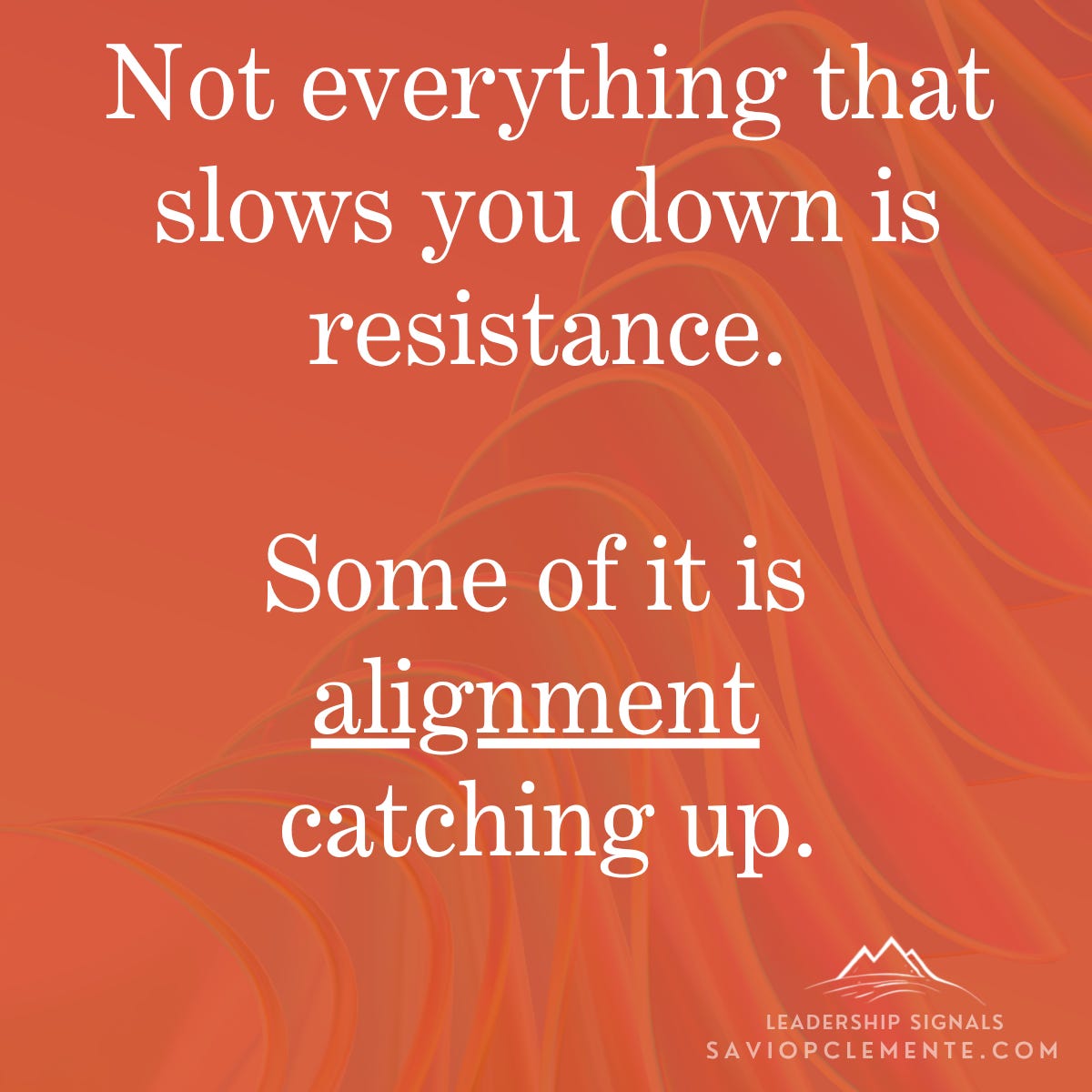
After my transplant, I wanted to return to the person I was before my second bout with cancer. Eventually, I realized that was the wrong destination. The work was not about returning. It was about integrating everything I had experienced and allowing it to shape the way I moved forward.
Because not everything we release is something we lost. Sometimes it is something we outgrew.
Today, I think about slowing down differently. I no longer see it as a detour. I see it as recalibration, an opportunity to listen, reassess, and make sure the direction I am moving in still matches the destination I am working toward.
Because progress is not always about moving faster. Sometimes progress is having the wisdom to recognize that the pace needs to change. And sometimes the thing slowing you down is not holding you back. It is actually preparing you for what comes next.

I’m a journalist, keynote & TEDx speaker, best-selling author, and creator of Adaptive Resilience Leadership, a framework for leaders navigating what I call the Post-Crisis Leadership Gap: the period after disruption when performance is expected to return, but clarity has not fully recovered. I write about how judgment shifts under pressure, why decision quality can quietly degrade, and what it takes to restore clear thinking in high-stakes environments. I’ve interviewed more than 2,000 leaders, experts, and cultural figures across healthcare, business, and leadership. Across those conversations, one pattern continues to emerge: performance does not fail first. Clarity does. I’m also a board-certified health & wellness coach (NBC-HWC, ACC) and a two-time cancer survivor. After a life-saving stem cell transplant, I rebuilt my relationship with recovery, perspective, and decision-making under sustained pressure. 🔗 saviopclemente.com ↗