

There are decisions we know we need to make, but somehow we never seem to make them. We tell ourselves we need more information, a little more time, another conversation, or better circumstances. Sometimes that is the right thing in the moment. However, good leadership requires judgment, and not every decision should be rushed because people are asking for an answer. But I have also learned that there is a point where waiting stops being thoughtful and starts becoming its own decision. The difficult part is recognizing when you have crossed that threshold, because delay rarely feels like failure while you are doing it. More often, it feels responsible. It feels like you are being careful and protecting the organization from making the wrong move.
I became far more aware of this after my stem cell transplant. During treatment, there was very little ambiguity about what needed to happen next. There were appointments, medications, chemotherapy, immunotherapy, blood tests, scans, hospital stays, and a medical team making decisions based on what my body needed at the time. Recovery, however, was different. Once I was stable enough to begin rebuilding my life, there was no single treatment plan that told me exactly how to live again. I had to decide what I was ready for, what I needed to leave alone, when to push myself, and when to take a pause and wait. At times, waiting was the right choice. My body needed time. There were also moments when I realized I was using uncertainty as a reason not to act. I was telling myself I needed to know more before taking the next step when, in reality, I already knew enough to begin.
That distinction mattered to me because uncertainty rarely disappears completely. We imagine that clarity arrives first and action follows. But in reality, some clarity only comes after we move. You can think about a decision for weeks, gather more information, talk to more people, and still feel uncertain. At some point, the question changes from “Do I know enough?” to “Am I using the need for more certainty to avoid making a decision?” And I have learned that the second one is often harder to answer.
There is another reason delay can be so difficult to recognize. It gives us something productive to do. From the outside, it can look like progress. The calendar is full, conversations are happening, and work is being done.
The decision itself remains untouched.
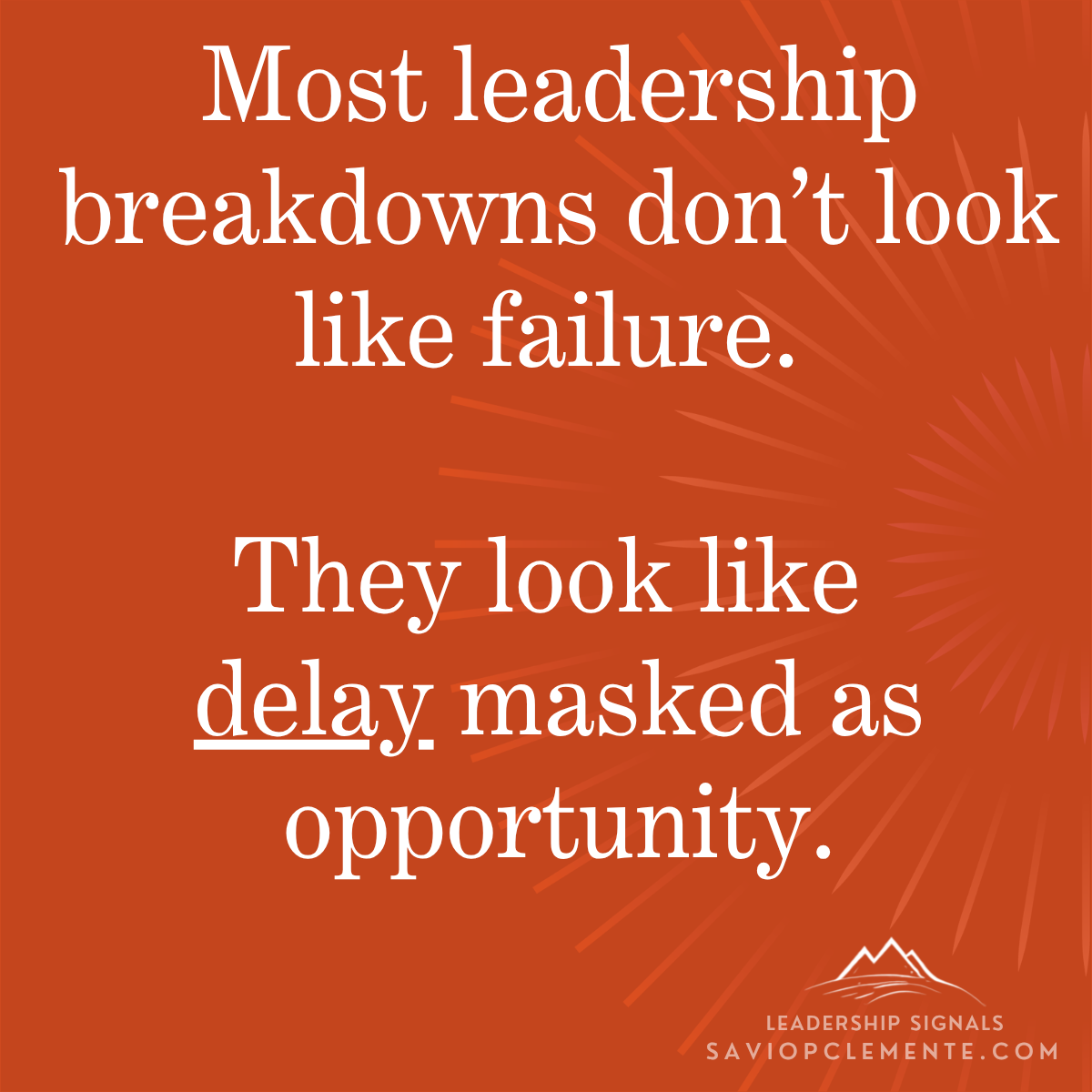
That is where I think leaders need to become honest with themselves. There is a difference between creating the conditions for a better decision and postponing a decision because making it carries consequences. The first is leadership. The second can become avoidance, even when it is wrapped in thoughtful language.
I have seen versions of this in conversations with healthcare executives. The organization knows that something is not working, but the problem is complicated enough that everyone can justify waiting. A process is creating unnecessary friction, but because people have learned to work around it, there is no obvious crisis forcing anyone to change it. A leadership issue continues to surface, but the conversation gets deferred because there are more immediate operational priorities. A strategic initiative no longer has the clarity it once did, yet instead of deciding whether to stop, leaders continue adding resources in the hope that something will eventually change. Nothing is collapsing. That is what makes these situations so difficult. An organization can continue functioning for a surprisingly long time while the cost of not deciding quietly accumulates.
I think we sometimes underestimate that cost because delay does not arrive with a price tag. A team loses confidence because an issue was raised but never resolved. A leader becomes frustrated because the same conversation keeps returning. People adapt to workarounds that were supposed to be temporary. Eventually, what began as a decision to wait becomes part of how the organization operates.
We say we are keeping our options open when what we are really doing is avoiding the responsibility of closing one of them. I have had to confront that personally as well. After everything my body had been through, I became very aware of how easy it is to keep waiting for the perfect moment to feel ready again. There was always another reason to wait. More energy would be better. More certainty would be better. A little more recovery would be better. But life does not always give us the clarity we want before asking us to move. At some point, I had to accept that rebuilding was not going to happen because I suddenly felt completely ready. It was going to happen because I began making decisions with the information, energy, and capacity I actually had. That experience changed how I think about leadership. Indecision rarely stays with the person making the decision. It spreads across the organization. Teams wait for direction, projects remain unresolved, and people spend energy trying to interpret what leadership might eventually decide.
I have come to believe that one of the most important questions a leader can ask is, “What are we allowing to continue because we have not decided what to do?” The question shifts attention from the risk of making a change to the cost of leaving something unresolved.
That is something I understand differently now than I did before my stem cell transplant. I used to think momentum came primarily from action. Now I think it also comes from resolution. Sometimes the next step is not to do more. The next step can be deciding what no longer deserves to remain open. There is freedom in that. Most leadership breakdowns do not begin with a dramatic failure. The breakdown often starts much earlier, when something needs to change but the decision keeps getting pushed aside. By the time everyone can see the problem, the organization may have already spent months or years adapting to it. The most important decision a leader can make is to stop calling delay an opportunity.

I’m a journalist, keynote & TEDx speaker, best-selling author, and creator of Adaptive Resilience Leadership, a framework for leaders navigating what I call the Post-Crisis Leadership Gap: the period after disruption when performance is expected to return, but clarity has not fully recovered. I write about how judgment shifts under pressure, why decision quality can quietly degrade, and what it takes to restore clear thinking in high-stakes environments. I’ve interviewed more than 2,000 leaders, experts, and cultural figures across healthcare, business, and leadership. Across those conversations, one pattern continues to emerge: performance does not fail first. Clarity does. I’m also a board-certified health & wellness coach (NBC-HWC, ACC) and a two-time cancer survivor. After a life-saving stem cell transplant, I rebuilt my relationship with recovery, perspective, and decision-making under sustained pressure. 🔗 saviopclemente.com ↗